

The 2019–20 coronavirus pandemic is a pandemic of coronavirus disease 2019 (COVID-19) caused by the severe acute respiratory syndrome coronavirus 2 (SARS-CoV-2). The disease was first identified in Wuhan, Hubei, China in December 2019.The World Health Organisation(WHO) declared the outbreak a a pandemic on 11 March.
Immediate effect: Shares hit across economies
Big shifts in stock markets, where shares in companies are bought and sold, can affect the value of pensions or individual savings accounts (ISAs).
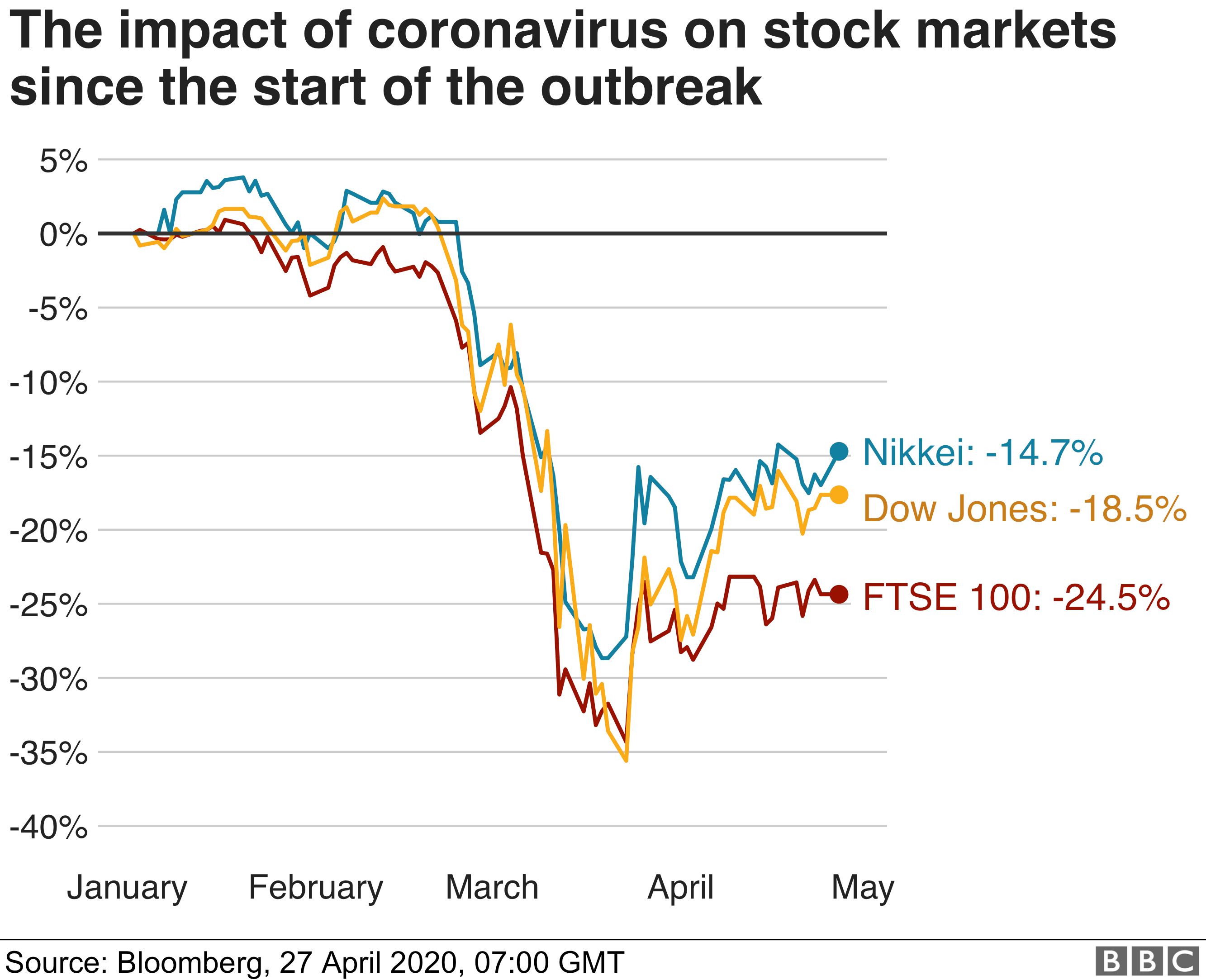
The FTSE, Dow Jones Industrial Average and the Nikkei have all seen huge falls since the outbreak began on 31 December.
- U.S. stocks underwent a selloff. The S&P 500 was down 1.3%, while the Dow Jones industrial average and the Nasdaq Composite fell 1.3% and 1.6%, respectively.
- Global markets also took a hit from the China virus fears, with the Stoxx Europe 600 index falling 2.1%, Germany’s Dax 2.3%, France’s CAC 50 2.4% and the iShares MSCI Emerging Markets ETF almost 4%.
- While Chinese and most Asian markets were closed due to the Lunar New Year holiday, Japan’s Nikkei 225 index fell more than 2%.
- Coronavirus fears have been worrying investors since last week; U.S. stocks last Friday recorded their first weekly loss of the year, with the S&P 500 having its worst week in six months.
The Dow and FTSC see a big drop in first three months of the year since 1987.
Impact on macroeconomic variables
Containment measures have led to further downward predictions of world GDP growth
On 14 April, the International Monetary Fund updated its global growth projections from only three months ago, indicating that the global economy is expected to experience its worst recession since the Great Depression, surpassing the deep economic slump following the global financial crisis a decade ago. Earlier in April, the UNDESA analysed the effects of the containment measures and projected that the world economy could, in the worst-case scenario, contract by up to 1 per cent. Similarly, the OECD stated in early March that increasingly stringent lockdown measures in most of the world’s advanced economies would inevitably result in significant declines in GDP growth.
The impact on employment will be worse than initially expected
The ILO’s previously predicted rise in unemployment of up to 25 million in 2020, with losses in labour income in the range of USD 860 billion to USD 3.4 trillion, seems accurate, if not underestimated. According to the ILO, these numbers may underestimate the real magnitude of COVID-19’s impact. The current containment measures are affecting close to 2.7 billion workers, representing around 81 per cent of the world’s workforce.
Developing countries are expected to suffer the most
The crisis is expected to hit workers in low- and middle-income countries particularly hard, where the share of those working in informal sectors, and who therefore have limited access to adequate health and social protection, is higher. To make matters worse, the expected massive job losses among migrant workers will likely have knock on effects on economies that heavily depend on remittances. Furthermore, the containment measures in advanced economies have already started impacting less developed countries through lower trade and investment.
Capital flight from developing countries at unprecedented rates
The rattling of financial markets, together with tightened liquidity conditions in many countries, have led to unprecedented outflows of capital from developing countries. UNCTAD illustrates the net debt and equity outflows from the main emerging economies, which amounted to USD 59 billion in the month since the COVID-19 crisis went global (21 February to 24 March).
The UN has expressed concern that the COVID-19 crisis will lead to a reversal of decades of progress in the fight against poverty, and that already high levels of inequality within and between countries will be further exacerbated. The crisis will therefore inevitably and adversely impact the implementation of the 2030 Agenda for Sustainable Development. The COVID-19 pandemic is expected to negatively influence almost all SDGs. The current crisis will also severely affect the prospects for industrialization in developing countries.
Impact on trade and manufacturing production
COVID-19 is severely impacting manufacturing production in developing countries because: 1) demand from high-income countries for manufacturing goods and raw materials is decreasing; 2) value chains are being disrupted due to delays in the delivery of necessary components and supplies from more technologically advanced countries; 3) other factors, including policies (e.g. restriction of movement of goods and people), inability of employees to reach the workplace or financial constraints, which affect the normal p
It has been estimated a USD 50 billion decrease in manufacturing production in February 2020, and the IMF warns that the negative economic effects will be felt “very intensively” in developing countries that sell raw materials. All these negative channels will inevitably have an impact on exports from developing countries. The losses in export volume will be further intensified by the decline in energy and commodity prices. Projects that developing countries as a whole (excluding China) will lose nearly USD 800 billion in terms of export revenue in 2020.
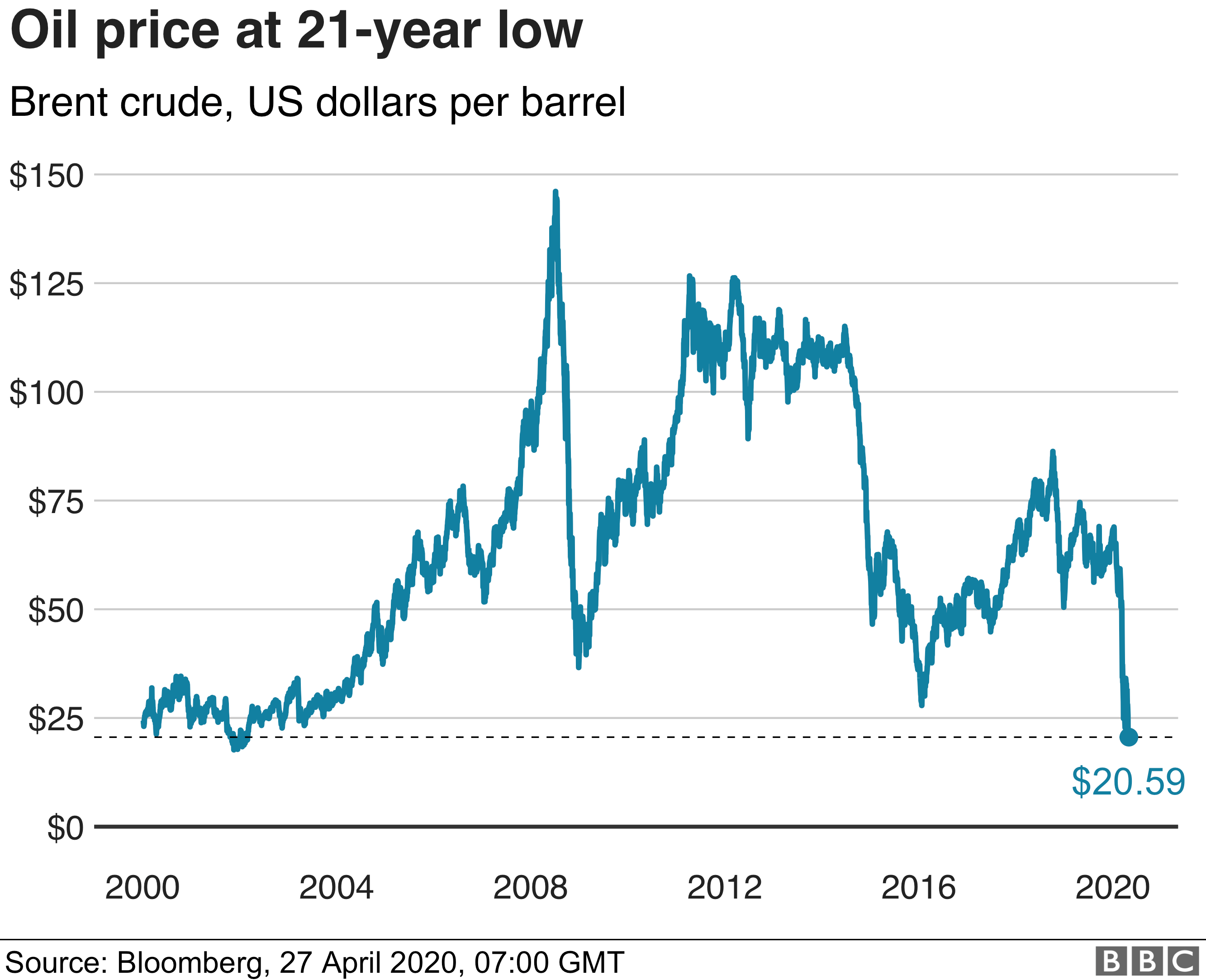
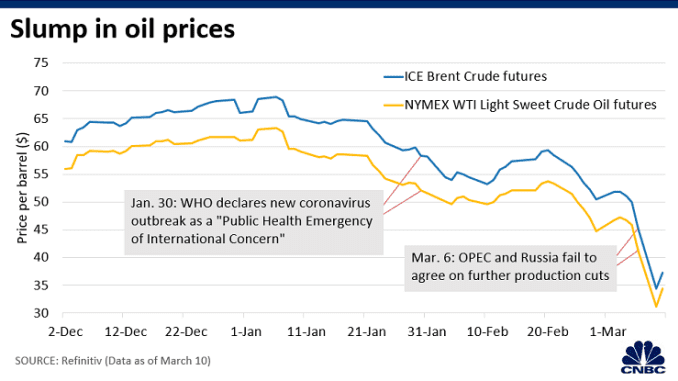
Oil prices crash
Demand for oil has all but dried up as lockdowns across the world have kept people inside.
The crude oil price had already been affected by a row between Opec, the group of oil producers, and Russia. Coronavirus has driven the price down further. Although Opec and other countries have now agreed to cut production, the world still has more crude oil than it can use. The IMF described the decline as the worst since the Great Depression of the 1930s. Although it said that the corona virus has plunged the world into a “crisis like no other”, it does expect global growth to rise to 5.8% next year if the pandemic fades in the second half of 2020.
Affect on Tourism
When it comes to the tourism sector, the damage of the coronavirus is as much about the seriousness of the virus itself as its inauspicious timing. China’s Lunar New Year begins on Friday, which under normal circumstances would kick off the biggest annual mass movement of people in China, and indeed the world.
An estimated 400 million Chinese travelers totaling 3 billion trips were expected to travel for the several-weeks-long holiday period to other areas of China and countries across the Asia-Pacific region.
This creates a major challenge for the destinations bracing to receive (and now, monitor) all those arriving tourists. In keeping with World Health Organization advice, screening for passengers arriving from China with the use of thermal scanners
Another challenge is the expected loss of revenue that will occur as a result of many travelers staying home. The quarantine means that millions of people are unable to leave the region, including on flights. As such, a significant drop in the volume of people traveling for the season from that region is to be expected. In other regions, it’s likely that people will stay home or cancel trips out of fear or precaution. This could have economic implications similar to the SARS crisis of 2003
The 2003 SARS crisis created a severe negative impact on GDP growth for the Chinese economy and also hit the economies of a number of Southeast Asian nations, including Malaysia, Singapore, and Vietnam. However, other economies are also vulnerable, with the SARS epidemic having also had a negative impact on the economies of Canada and Australia. Since the 2003 SARS crisis, China’s international tourism has boomed, so the risks of a global SARS-like virus epidemic spreading globally have become even more severe.
The US is projected to loss 4.6 million jobs due to impacts of Coronavirus. This alone would increase un employment rate to 6.3% in the US
Developing world problems
Take the closure of schools. In the global North, this is an inconvenience for parents. E-learning platforms aside, it is also an educational setback for students, especially if it entails postponing of exams. Yet dispiriting as this all is, it is not a vital threat.
By contrast, for many children in the global South 85 million in Latin and caribbean alone – school closures mean no more school meals. Which in turn (in some African households in particular) means an end to the only hot meal anyone among family members would get in a day.
Already before the corona virus crisis, more than 820 million people went to bed hungry. This is an enormous number to grapple with, not just morally but from a policy perspective.Across the globe, the public policy response to the pandemic has been guided by the imperative to preserve life and health, and rightly so. But an unwanted repercussion could be to deepen hunger even further – possibly very soon.
Unlike in the crisis of 2007/2008, and despite anecdotal reports of empty supermarket shelves, the risk today is not one of immediate shortages. The global supply of food remains strong. The big question mark hangs over supply chains.
There is evidence that quarantine regulations and partial port closures are causing slowdowns and logistical hurdles in the shipping Industry. Amid border restrictions, trucking faces similar threats.

The concern is not all about ready consumables: transport constraints can drastically affect the supply of fertilizers, veterinary drugs and other agricultural inputs. The shuttered restaurants and less frequent shopping trips are meanwhile curbing demand and will ultimately depress output. In the West, reduced labor mobility threatens to rotting in the fields and deprive producers of their livelihoods. In Africa, during the Ebola crisis, food production plummeted by 12%.
Whatever are the impacts are currently it is better for the world and people to follow the orders of the government and support each other until the treat of the virus would be relieved and hopefully we would be able to find a vaccine soon for the pandemic
References: https://www.bbc.com/news/business-51706225
https://www.weforum.org/agenda/2020/04/covid-19-pandemic-disrupts-global-value-chains/
https://unctad.org/en/pages/newsdetails.aspx?OriginalVersionID=2347

 Nerd Economics
Good info Lokesh 😊 li will add my thoughts to it. on an average Every person is going to be impact with this pandemic. Mainly the labour wages will get low or no more hikes. And many of the labour works can’t retain there jobs , and the cost of the product(daily routine use stuff ) not on oil up-to 1 year or more , price will increase as unemployment increases people will get less money to live .. How long do you thing it to be like a normal stage stocks and all .
My Guess 2 -5 years .and
it will impact USA Election too .
What exactly happen at Obama first term , it can cause same impact . But here luckily banking sector is still managing . Or may be they can bluff there stocks too..
I like to know more , how all countries will effect when USA is printing the currency to 2-3 trillion dollars. If You like to post any blog or stuff on that many of your followers like me will know more things 😁,
LikeLike